KAUST · CEMSE Divisionعربي
01 / 05
Use arrow keys · F for fullscreen
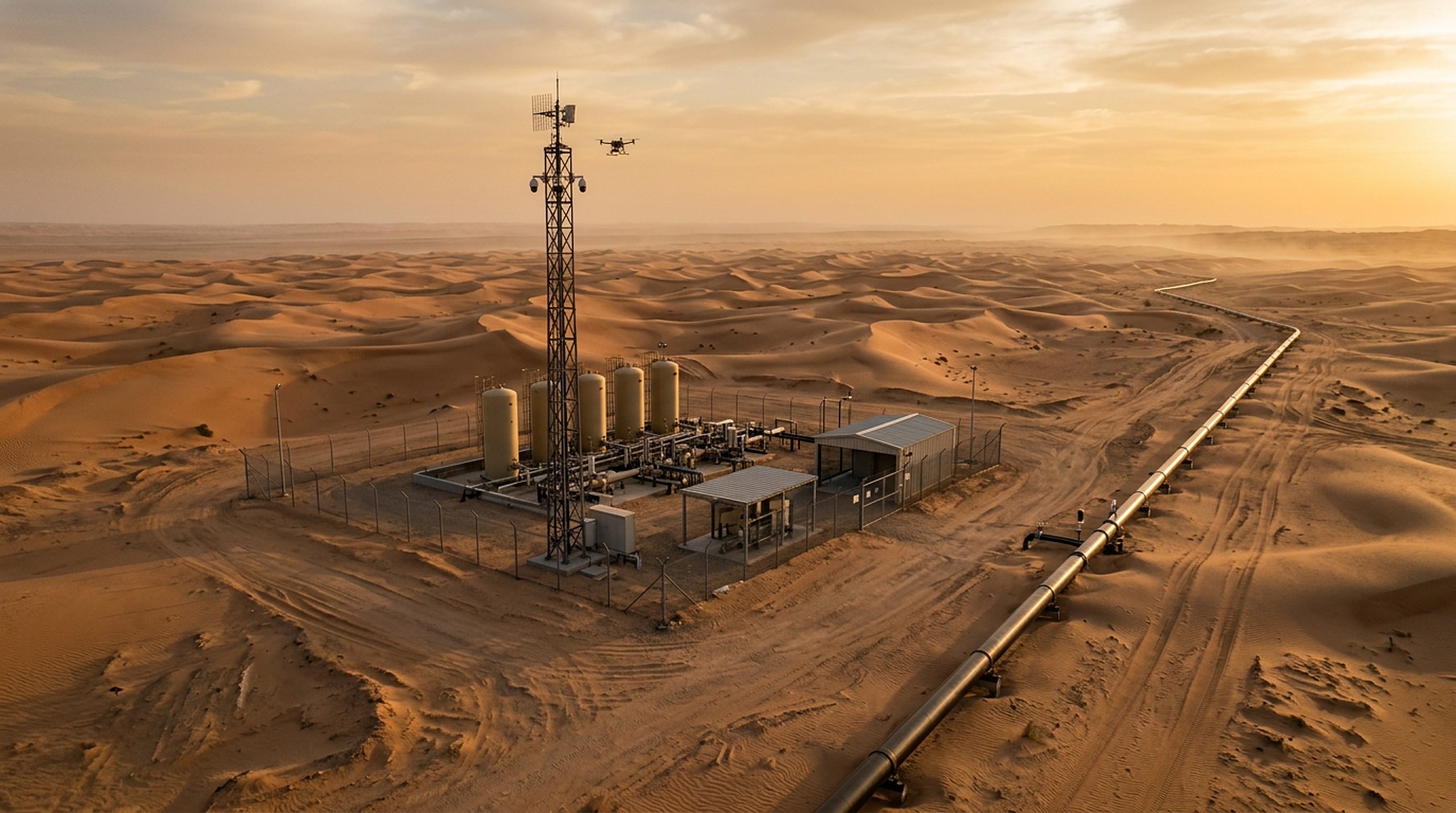
Concept for Aramco sites

Check Before You Act

Reliable early warning of unidentified drones around stations and plants, built on the cameras and inspection drones Aramco already runs. The system raises a verified flag. Aramco decides.

Basem Shihada  ·  CEMSE Division, KAUST  ·  2026
The Idea

Listen, look, cross-check… then raise a flag

Like a guard who hears an alarm and checks the camera before calling anyone: every suspicious radio signal is treated as a claim to be checked, not a fact. The system blocks nothing itself. It gives Aramco security a verified alert with the evidence behind it.

1
Which signal is the stranger?Aramco's own drones and networks share the same airwaves, and a broadcast ID can be faked.
2
Sometimes there is no signal at allSome drones fly a pre-set route with no radio link.
3
Blanket blocking reaches our own systemsConventional answers cut every signal nearby, including Aramco's own drones and networks.
Radio signalwhat the receivers hear
Fixed camera + inspection dronewhat the cameras see
Drone's own IDwhat it claims to be
Nearby sensorswhat neighbours report
Do they
agree?
VISTA · cross-check
No alertOurs, or harmless
Flag: unidentified, with a linkLink, location, evidence and confidence attached
Aramco security decides any response

Built on the CCTV and inspection drones already in place, with a small low-power edge computer per camera. No video leaves the site.

Live detection demo

Two independent eyes on the same drone

The fixed station camera, and an inspection drone that happens to be in the air. Each detects the intruder independently on its own edge computer, and both reports join the cross-check. In the fixed-camera clip the box is live vision-language-model output on every frame; in the drone-view clip the model detects the drone on the first frame and it is then tracked automatically. Nothing is hand-drawn.

FIXED CCTV · EDGE NODE 03VLM · EDGE CAMERAVISTA
INSPECTION DRONE · CAM-AVLM · ONBOARD DRONE CAMVISTA
VERIFIED ALERTUnidentified drone near the stationevidence attached
CONFIDENCE0.82
SOURCES AGREEING4 of 5fixed camera · inspection drone · radio · sensors  |  no broadcast ID
RADIO LINKLink foundfrequency + bearing attached

Alert card = illustrative sample data · footage generated for the demo

Ops console · live

Layers over the map: what is verified, what is not

Verified drones on their plans, a feed for every camera and drone, and a claim that is checked until it becomes a verified alert with a narrow zone. Open full screen ↗

What we have · what we build

A ready starting point, and a 12-month plan

97%+
Checker accuracygives the right answer in more than 97% of cases
~3 ms
Decision timeabout three thousandths of a second
14×
Lighter model, better descriptionsbeats a model 14 times its size
−50%+
Second drone's reportcuts what slips through by more than half

Current VISTA results. Designed from the start to run onboard drones.

MONTHS 1–4
Receive and recordFit radio receivers to our lab drones alongside their cameras and processors; record real drone signals at a KAUST test site.
MONTHS 5–8
Extend VISTACross-check onboard between the radio signal, the camera view, the drone's ID and reports from nearby sensors.
MONTHS 9–12
Live demo at a mock pump stationA friendly "intruder" drone with an Aramco-style inspection drone; measure detection reliability, false flags and alert speed.
Basem Shihada  ·  CEMSE Division, KAUST